
Are Olive Wood Cutting Boards Safe to Use?
Updated: Aug 21

Olive wood cutting boards are safe to use when they are properly made, properly dried, properly finished, and properly cared for. In my opinion, they are one of the most natural, durable, and beautiful kitchen tools you can bring into your home.
I have personally used olive wood boards for about 10 years and have been selling them through Olive Wood Work since its Canadian launch in 2024. During this time, I have handled many boards, used them in real kitchens, seen how they age, and listened to what customers notice after bringing them into their homes.
The short answer is this: yes, olive wood cutting boards are safe. But the real answer is more important than that. A good olive wood board is not just safe. It is natural, long-lasting, meaningful, and beautiful enough to use for both food preparation and table presentation.
Why Olive Wood Is a Safe Material for Cutting Boards
Olive wood is a very hard and dense hardwood. This makes it strong enough for daily kitchen use, cutting, serving, and presentation. A well-made olive wood board should feel solid, heavy, smooth, and natural in the hand.
What I like most about olive wood is that it does not feel artificial. It has a natural scent, a rich grain, and an organic character that makes it very different from mass-produced boards found in regular stores.
At Olive Wood Work, the boards we offer are usually made from one solid piece of olive wood. That matters because a one-piece board does not depend on glued sections, stains, or varnishes to look beautiful. The beauty comes from the wood itself.
A proper olive wood board should be:
Made from solid hardwood
Properly dried before carving
Smoothly finished
Free from varnish or synthetic coating
Easy to wash and maintain
Strong enough for regular kitchen use
My Personal Experience Using Olive Wood Boards for 10 Years
I have been using olive wood cutting boards personally for about 10 years. In that time, I have not had problems with cracking, splintering, strong unpleasant odors, or warping when the board was properly made and properly cared for.
What I have noticed is normal wear from knife use. After long use, the surface naturally develops knife marks. This is normal for any real cutting board. It does not mean the board is bad. It means the board is being used.
The good thing about olive wood is that it can be refreshed. If the surface becomes too scratched, it can usually be lightly sanded and oiled again to bring back a cleaner, fresher look.
That is one of the reasons I consider olive wood a premium board material. It is not a disposable kitchen item. With care, it becomes part of the kitchen.
Where Our Olive Wood Boards Come From
The olive wood boards from Olive Wood Work are carved in Crete, Greece from carefully selected mature olive wood. The material is prepared and dried before carving to improve stability and durability.
This is one of the parts of the story I personally love. The tree already lived a long life. It gave olives for generations. Then, when it is no longer productive, the wood is turned into something useful and beautiful for the home.
To me, this makes olive wood different from many modern kitchen products. It has history. It has character. It has a connection to the Mediterranean way of life.
How the Wood Is Dried Before It Becomes a Board
One of the biggest reasons olive wood boards are safe and durable is the drying process.
When I visited my friends in Crete, I had the chance to see part of this process myself. The wood is not rushed. It is kept for about 2 years under olive wood dust so it can dry naturally. Because Greece can be very hot, the wood cannot simply be overdried too fast. If wood dries too quickly, it can become unstable and may crack later.
The process includes careful moisture control. From what I saw and learned, the wood is sometimes watered and protected during the natural drying stage so it does not dry too aggressively in the heat.
After that, there is another stage using a large specialized dehumidifier. The wood is kept inside for around 10 to 14 days under controlled conditions to pull moisture from inside the wood.
This matters because a cutting board is only as good as the wood preparation behind it. If the wood is not dried properly, it can crack, move, or warp later. A beautiful board starts long before the carving stage.
Why One-Piece Olive Wood Boards Matter
Many of our one-piece olive wood boards are made from a single piece of olive wood, including boards with a handle carved from the same block. In my opinion, this is one of the most important quality points because it keeps the board natural, solid, and free from glued sections.
A one-piece board feels more natural and premium because it does not rely on glued sections to hold it together. It also allows the natural grain to flow across the board without interruption.
At Olive Wood Work, our boards are not stained, varnished, or covered with artificial finishes. They are finished with olive oil and beeswax to help protect the surface and bring out the natural colour and grain of the wood.
This keeps the board simple, honest, and natural.
Are Olive Wood Boards Safe for Food?
Yes, olive wood boards are safe for food when they are properly cleaned and maintained.
I do not like exaggerated claims. No cutting board should be treated as automatically clean just because it is wood, plastic, bamboo, or any other material. Food safety depends on how the board is used, washed, dried, and maintained.
From my experience, olive wood is excellent for:
Bread
Cheese
Fruits
Vegetables
Serving appetizers
Steak boards
Holiday table presentation
Decorative food displays
We also offer steak boards with a groove for juices. These are designed for serving and cutting meat. If you use a board for meat, the key is simple: wash it properly after use and allow it to dry fully.
Can You Cut Meat on Olive Wood Boards?
Yes, you can cut meat on olive wood boards, especially if the board is properly finished and cleaned after use.
That said, I recommend being practical. If you cut raw meat, poultry, or fish, clean the board right away with warm water and dish soap. Do not leave meat juices sitting on the surface for a long time.
For many families, it is also smart to use separate boards: one board for raw meat and another for bread, cheese, fruit, and ready-to-eat foods. This is not because olive wood is unsafe. It is because separating raw meat from ready-to-eat food is a good kitchen habit with any board material.
Cleaning an olive wood cutting board is simple.
After use, wash the board by hand with warm water, mild dish soap, and a soft sponge. Rinse it well and let it dry naturally in open air.
Do not leave the board sitting in water. Do not soak it in the sink. Do not put it in the dishwasher. Too much water and heat can damage natural wood over time.
The basic care routine is:
Wash by hand with warm water and mild soap
Use a sponge, not aggressive metal scrubbers
Rinse well
Dry upright or leave it in open air
Do not soak
Do not put in the dishwasher
Oil lightly when the board starts looking dry
How Often Should You Oil an Olive Wood Board?
How often you oil the board depends on how often you use it.
If you use it mainly for serving, you may only need to oil it occasionally. If you use it often for cutting, you may want to refresh it every month or every 2 months.
Personally, I like to oil the board lightly when it starts to look dry or when I want to bring back the rich colour of the grain. A small amount is enough. You do not need to over-oil it.
For routine care, use food-grade mineral oil or a food-safe board conditioner or beeswax-based product. Apply a light coat and wipe away any excess.
What to Do When the Board Gets Scratched
Knife marks are normal. A cutting board is made to be used.
After long use, olive wood can develop many small cuts from knives. This does not mean the board is finished. In many cases, it can be refreshed.
If the board becomes heavily scratched, you can lightly sand the surface and oil it again. Depending on the level of use, this may only be needed once a year or once every couple of years.
This is one reason I like olive wood. It ages naturally, but it can also be restored. It is not like a cheap board that you use for a short time and throw away.
Why Olive Wood Feels More Premium Than Regular Store Boards
In my opinion, olive wood is more premium than many regular boards because every piece is different.
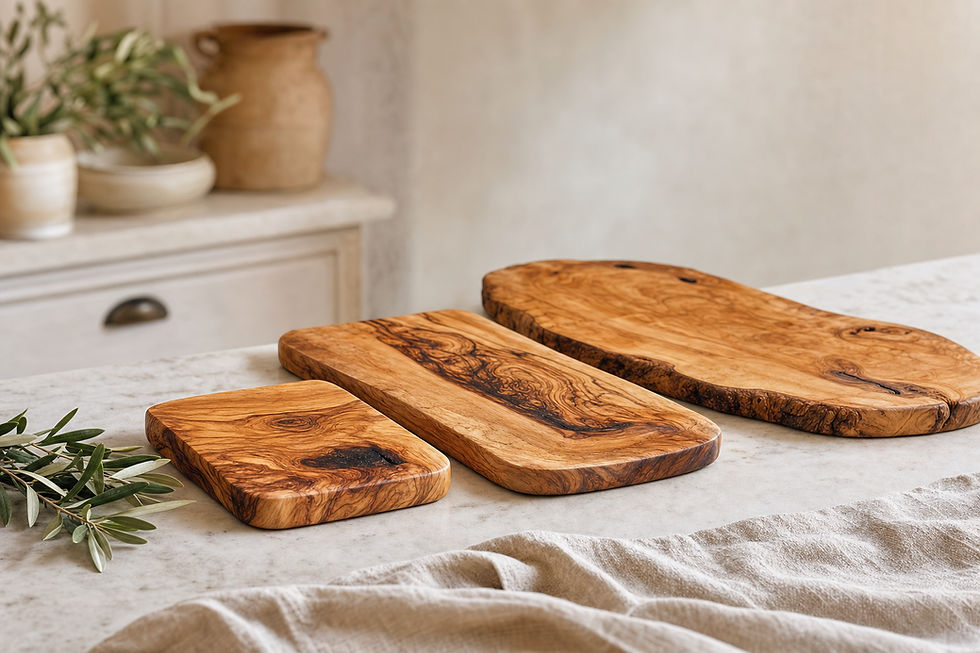
The grain, colour, shape, and structure are never exactly the same. Some boards have dramatic dark lines. Others have golden tones, soft curves, or natural edges. This gives each board its own personality.
Many customers do not use olive wood boards only for cutting. They use them for serving cheese, bread, fruit, desserts, and appetizers. They place them on holiday tables because the board itself becomes part of the presentation.
This is something we noticed clearly: people love seeing olive wood boards on the table. They bring warmth and charm to the kitchen and dining room.
Why Personalization Makes Olive Wood Even More Special
One of my favourite things is adding a small engraved element to an olive wood board.
It can be a name, date, family message, wedding detail, cottage name, business logo, or something connected to the person receiving the board. This small detail changes the feeling completely.
A regular cutting board is just a kitchen tool. A personalized olive wood board becomes a gift with meaning.
This is where olive wood is different from mass-produced boards. The board already has natural character, and engraving makes it personal.
Personalized olive wood boards are especially good for:
Wedding gifts
Housewarming gifts
Anniversary gifts
Corporate gifts
Holiday gifts
Family kitchen gifts
Restaurant or café presentation boards
Are Olive Wood Cutting Boards Better Than Mass-Produced Boards?
In my opinion, yes, if you care about natural material, durability, beauty, and meaning.
A mass-produced board can be useful, but it usually does not have the same soul. Olive wood has natural grain, Mediterranean character, and a handmade feeling that is hard to copy.
For me, the value of olive wood is not only that it is safe. The value is that it is safe, natural, durable, and beautiful at the same time.
It is a board you can cut on, serve on, decorate with, gift to someone, and keep in your kitchen for years.
Final Answer: Are Olive Wood Cutting Boards Safe?
Yes, olive wood cutting boards are safe to use when they are properly made, properly dried, naturally finished, and properly cared for.
From my own experience using olive wood boards for about 10 years and selling them through Olive Wood Work, I believe they are one of the best natural kitchen tools you can own.
They are not only safe. They are more natural, more durable, and more meaningful than many mass-produced boards. They bring charm to the kitchen, beauty to the table, and a personal feeling that regular store boards usually do not have.
If you want a board that is useful, beautiful, and connected to real craftsmanship, olive wood is an excellent choice.


Comments