
Olive Wood Cutting Board vs Plastic: Which One Earns Its Place on Your Counter?
Plastic boards are cheap, light, and easy to replace. That is their pitch, and it is honest enough. But if you have ever pulled a scarred, grey plastic board out of the drawer and thought it is time again, you already know the trade-off. You are renting a tool, not keeping one.
Olive wood works differently. A good board stays with you. It goes from prep to table to gift photo and back to prep again. Here is how the two really compare once you stop looking at the price tag and start looking at the years ahead.
Daily Use: What Each Board Actually Feels Like
Plastic boards are flat, uniform, and forgiving on knives at first. Within a few months of real cooking, the surface fills with knife scars. Those grooves hold moisture and food residue, which is why most plastic boards get tossed and replaced on a cycle.
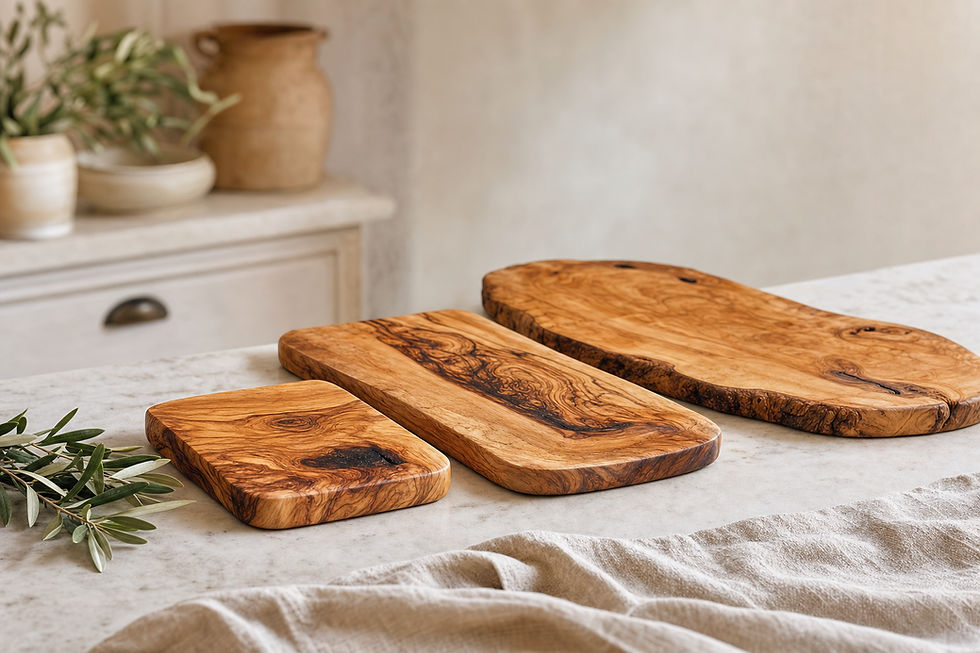
Olive wood behaves like a working tool. The grain is dense and tight, which is why Cretan artisans have been shaping it for generations. It absorbs the knife instead of splitting under it. Cuts close in. The surface develops a quiet patina with use, not damage.
There is a practical side to this too. An olive wood board feels heavy and planted on the counter. It does not slide around when you are rocking through an onion. You notice the difference the first time you use one.
Cleaning, Care, and the Honest Trade-Off
This is where plastic wins one round. You can put plastic in the dishwasher. You cannot do that with olive wood, and we will never tell you otherwise.
Caring for an olive wood board is simple, but it does ask something of you:
Hand wash with warm water and a little soap after each use.
Dry it upright so air moves around both sides.
Do not soak it. Standing water is the one thing that causes cracks.
Rub in food-safe mineral oil every month or so, more often in winter when indoor air gets dry.
That is the whole routine. Two minutes after dinner. In return, the board lasts for years and looks better the longer you own it. Plastic, by contrast, asks less and gives less. It does not age into something; it just wears out.
On the kitchen-safety side, research on wood vs plastic has been going back and forth for decades. We are not going to make a clinical claim here. What we will say is this: a clean, dry, well-oiled wood board, washed by hand, is a surface generations of cooks have trusted. Pair it with proper care and you have a tool that does its job.
Where the Board Comes From Matters
Most plastic boards are anonymous. You do not know who made them or where. That is part of why they feel disposable.
Our boards start in Crete, where the olive trees are part of daily life and the wood comes from pruned branches and trees at the end of their working life. Long-standing artisans shape each piece by hand and dry it slowly so it stays stable in a Canadian kitchen. The grain runs in swirls and waves you cannot fake. No two pieces are alike, which is the point. You are getting one board, not a copy of one.
From there, the boards come to our workshop in Oshawa. We finish them, sand the edges by hand, oil them, and engrave them if you want a name, a date, or a logo on the back. We ship across Canada. Free engraving is included on qualifying boards, and we will send a proof before we cut anything permanent.
When a Cutting Board Becomes a Gift
This is the part plastic cannot do at all. A plastic board is not a gift. An olive wood board is, and it tends to become one of the gifts people remember.
A few common ones we see:
Weddings and fifth anniversaries, with the couple's names and date engraved.
Housewarmings and closing gifts, often with the family name or the address of the new home.
Corporate thank-yous, with a logo on the back so the cooking side stays clean and useful.
The reason it works as a gift is the same reason it works in your own kitchen. It gets used. It goes on the counter, not in a closet. It earns its place.
So when you ask olive wood cutting board vs plastic, you are really asking what you want from a tool you reach for every day. One is meant to be replaced. The other is meant to be kept.


Comments